Mistakes That Delay Your First Bug Bounty (And How to Break the Cycle)
A realistic, experience-driven breakdown of common mistakes bug bounty beginners make before earning their first reward-and how fixing mindset, workflow, and habits can change everything.
⚠️ Disclaimer
This article is written for educational and motivational purposes only. It does not encourage illegal hacking or testing without permission. Always hunt responsibly within authorized bug bounty scopes, labs, or environments you own.
Introduction
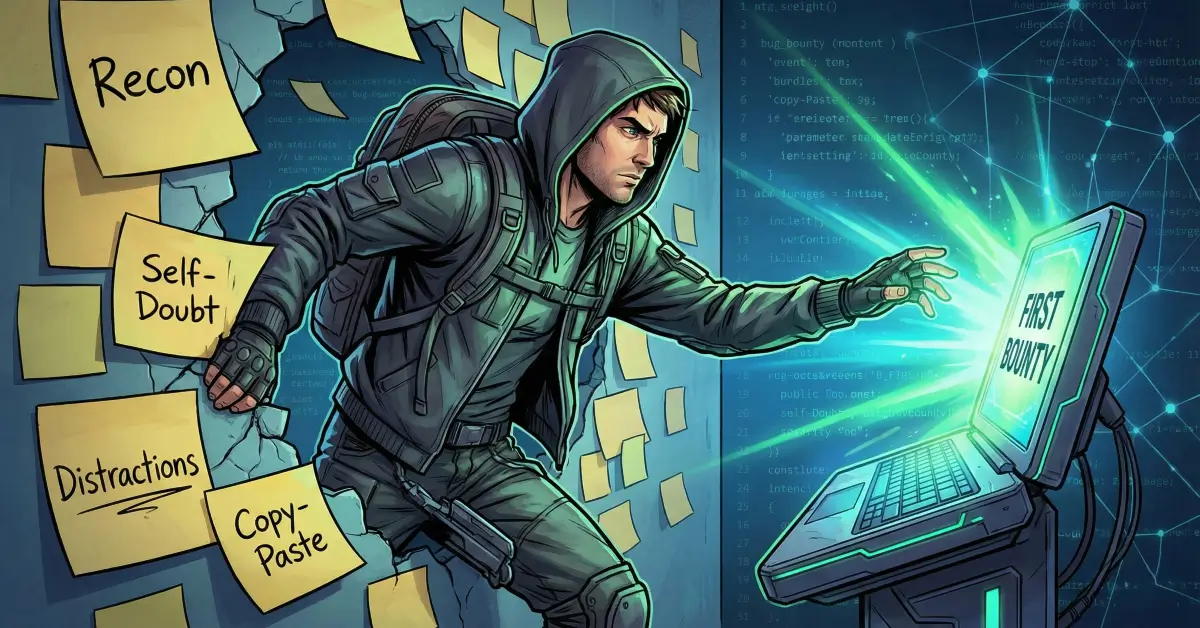
Most people who enter bug bounty don’t fail because they lack intelligence, talent, or technical skill. They fail because they unknowingly repeat the same mistakes-over and over-until frustration replaces curiosity.
This write-up is not about payloads, bypass tricks, or fancy exploit chains. It is about the human side of bug bounty hunting: habits, mindset, workflow, and misconceptions that silently block progress.
The original researcher shared these lessons after struggling to land a first bounty-only to earn one within a week of correcting them. That alone tells you something important: the problem often isn’t knowledge, it’s approach.
If you are still stuck in the “almost there” phase-doing recon daily, reading write-ups endlessly, yet never submitting anything-this article is for you.
Mistake #1: Confusing Recon With Hunting
One of the most common beginner traps is mistaking reconnaissance for actual vulnerability discovery.
Running tools like:
- subfinder
- waybackurls
- gau
- httpx
- openredirex
- 403 bypass scripts
- GitHub dorks
…feels productive. Terminals scroll, output files grow, and it looks like hacking.
But here’s the hard truth:
Recon is preparation. It is not hunting.
Recon tells you where to look. Hunting is what you do after that.
Many beginners spend days or weeks collecting subdomains, endpoints, and URLs-then never open Burp, never click through the app, never test workflows, never observe logic.
Real bugs-IDORs, CSRFs, broken auth flows, logic flaws-are rarely found by staring at recon output alone.
A healthier balance
If you are early in your journey and struggling:
-
Do minimal recon
- Subdomain enumeration
- Basic GitHub dorking
-
Then move immediately into:
- Manual browsing
- Intercepting traffic
- Understanding workflows
- Observing how users, roles, and permissions interact
Running Burp quietly in the background while you use the application normally often reveals more than hours of automated scanning.
Recon should serve hunting, not replace it.

Mistake #2: Letting Distractions Destroy Focus
Bug bounty requires deep concentration. Unfortunately, the same community that inspires learning can also destroy focus.
Common distractions include:
- Scrolling X (Twitter) endlessly
- Reading Medium posts mid-hunt
- Jumping between write-ups and tools
- Watching others’ success while ignoring your own work
The result? Fragmented attention and shallow testing.
A simple fix that actually works
Instead of trying to eliminate distractions entirely:
-
Allocate specific time blocks for:
- Reading write-ups
- Watching talks
- Scrolling social media
-
Outside that block:
- Lock distractions down
- Block sites if needed
- Use DNS filtering or browser extensions
When it’s time to hunt, hunt only.
Bug bounty rewards depth, not multitasking.

Mistake #3: Skipping Entire Functionalities
Another silent killer of progress is incomplete application coverage.
Many beginners test:
- Login
- Signup
- Profile page
…and then move on.
But mature programs-especially public ones-have already been scanned, pentested, and reviewed internally. The obvious surfaces are usually hardened.
High-impact bugs often live in:
- Forgotten features
- Rare workflows
- Edge-case functionality
- Settings pages
- Export/import features
- Admin-adjacent flows
- Collaboration features
- Account lifecycle actions (delete, leave, transfer, reset)
Why this matters
Critical bugs often appear where few people look.
The researcher highlights an important truth:
Most serious findings come from functionality no one tested-or logic no one questioned.
If you don’t fully understand how every feature works, you are testing blind.
Mistake #4: Blind Copy-Paste Payloads
Seeing a powerful payload from a respected hunter is tempting. Copying it everywhere feels efficient.
But copy-paste without understanding is one of the fastest ways to burn out.
Why?
Because payloads are context-dependent.
Examples
- AngularJS apps behave differently from React apps
- DOMPurify sanitization requires specific bypass logic
- Server-side rendering differs from client-side rendering
- Tomcat vulnerabilities differ from Node or Nginx
- GraphQL behaves differently than REST
Spraying the same payload across unrelated contexts:
- Wastes time
- Produces noise
- Triggers rate-limits or bans
- Teaches you nothing
A better approach
Before testing payloads, ask:
- What framework is this app using?
- Is this reflected, stored, or DOM-based?
- Is sanitization server-side or client-side?
- What encoding context am I in (HTML, JS, attribute, URL)?
Understanding why a payload works matters far more than knowing which payload works.
Mistake #5: Lack of Self-Confidence
This is the most damaging mistake-and the least talked about.
Many capable researchers:
- Solve PortSwigger labs
- Complete Hack The Box machines
- Finish TryHackMe paths
…but never submit to real programs.
Why?
Because they believe they are “not ready yet”.
The irony is painful: they are often more prepared than people already earning bounties.
Self-doubt creates a loop:
- “I need to prepare more”
- More labs
- More tutorials
- More hesitation
- No submissions
At some point, preparation becomes procrastination.
A hard but honest truth
Bug bounty skill grows after submission-not before.
Rejection teaches more than labs ever will.
Duplicate reports, invalids, low-severity ratings-all of them sharpen your judgment faster than theoretical practice.
The quote shared by the researcher captures this perfectly:
“The only difference between a Master and a Beginner is that the master has failed more times than the beginner has even tried.”
Failure is not proof you are bad. It is proof you are playing the real game.

The Week Everything Changed
The most powerful part of this story is not the mistakes-it’s the outcome.
Once these mental and workflow shifts were made, the researcher landed their first bounty within a week.
Not because they learned a new exploit.
Not because a secret payload appeared.
But because they:
- Focused on manual testing
- Covered full functionality
- Thought critically
- Trusted their instincts
- Stopped underestimating themselves
This pattern repeats across countless successful hunters.
What This Teaches New Hunters
For beginners
- You don’t need to know everything
- You need to start submitting
- Depth beats tools
- Confidence beats perfection
For intermediate hunters
- Audit your habits, not just your tools
- If you’re stuck, the issue is likely workflow-not skill
- Revisit “boring” features
For everyone
Bug bounty is not just technical.
It is emotional, psychological, and habit-driven.
Closing Thoughts
This write-up isn’t about blaming beginners-it’s about freeing them.
If you’ve ever felt stuck, unworthy, or “almost ready,” remember this:
The difference between those earning bounties and those still preparing is often one submission.
Be patient with your learning-but stop being harsh with yourself.
Hunt consciously. Fail proudly. Submit bravely.
Happy hacking. 🛡️